

Confronting Monsters with Care and Joy
This post is the one of many capstone projects from the inaugural 2026 cohort of the Rebus Luminary Fellowship for Education Leaders. Each Luminary Fellow was invited to share a reflection with the broader community. Today, we hear from Christina Hendricks, Professor of Teaching in philosophy at the University of British Columbia.
When I started this fellowship I had a specific challenge in mind that I was hoping to address: how to lead with care and meaningful support when so many people are exhausted and overwhelmed. There are multiple reasons why this is happening, including geopolitical events, injustice and oppression, financial pressures, precarity of work, significant changes to education, work, and many aspects of life due to AI, and so much more.
For some students, staff, and faculty, the challenges and stress feel more intense over the last few years; for others, this is and has been their daily reality for a long time. As I wrote in my Rebus Luminary Fellowship application:
Many of us are struggling with mental and physical health, and yet our institutions keep going at the same pace with the same expectations as if we can meet the moment with only small tweaks to our usual ways of operating. Perhaps because it is no longer working for a lot of people, many are finally realizing what those whose moments have never been met by the university have been saying all along, that our “usual” only works for some, and even those not very well.
My question going into the fellowship was, and is, how can leaders support ourselves, and others, when the cracks in “this is fine” are finally becoming more widely recognized? The stakes were also personal for me, as I was going through a serious health situation when writing those words that, unbeknownst to me at the time, would end up changing my leadership trajectory significantly.
A culture of care
One of the many things I appreciated about the fellowship experience was the enduring focus throughout on care, mutual support, wellbeing, and joy. This was clear from the very beginning, in the shared values grounding the fellowship: reciprocity, authenticity, celebrating joy, agency, and curiosity. It was clear in the group agreements, which included “be as present as your brain and circumstances allow”— encouraging us to recognize and validate when our own circumstances may call for multiple forms of presence, or when needed, absence.
This focus on care and joy (among other important ideas) can be found in the liberatory leadership framework that was a touchstone throughout the fellowship. Liberatory strategies discussed in the framework (pp. 37-43) include:
“Incorporate play to cultivate a culture of joy and facilitate innovation,” as one way to “recapture the joy that oppressive systems, structures, and experiences constantly try to steal from us.”
“Adopt a culture of care” to “center care and connection, value pleasure and thriving” for oneself and others.
Many of the activities we did in the fellowship mapped well onto these strategies. For example, in one meeting we intentionally named some monsters we are facing: challenges and difficulties that we brought with us into the room and into the fellowship. These could be personal or professional, and of course, we could share as much or as little as we wished with the rest of the cohort.
Asking us to take the time to name and sit with some of our monsters was in itself a valuable practice of care, as it invited us, as whole beings who struggle and feel, into a space where those struggles and emotions were recognized and validated. Being intentionally invited to bring our monsters into a shared discussion, and creating a supportive enough space that people felt comfortable doing so, respects the varying realities of what people in the room are experiencing.
“Being intentionally invited to bring our monsters into a shared discussion, and creating a supportive enough space that people felt comfortable doing so, respects the varying realities of what people in the room are experiencing.”
In some other professional spaces, difficulties and challenges, and our emotional reactions to them, are too often considered a distraction from “the work” instead of a crucial component of it.
We didn’t stop at the monsters though; we were encouraged to also think of joyful practices that could help sustain us while we confront them. Living in the world, and working towards equity and justice, can be difficult and exhausting, and we need moments, hours, and days of joy as well. This, too, is an essential part of “the work” rather than a peripheral “nice to have.”
Later, we each created a “dopamine menu” for ourselves, with activities that support motivation and joy. This included, e.g., “starters” (activities that take 10-15 minutes), “mains” (take at least an hour and require deep focus), “desserts” (provide a burst of joy but are best enjoyed in moderation), and more.
It was refreshing to take time in a professional development setting to seriously reflect on and plan for practicing the joys that will sustain us.
And we had dedicated time on one of the in-person days to have fun connecting and chatting while we decorated paper lanterns we used at the end of our time together in a wonderful, joyful closing ritual.
“Over my time in the fellowship, it gradually became clear to me that when talking about creating a culture of care, the emphasis was as much on caring for ourselves, and each other, as it was on extending care to others through our leadership roles. ”
Over my time in the fellowship, it gradually became clear to me that when talking about creating a culture of care, the emphasis was as much on caring for ourselves, and each other, as it was on extending care to others through our leadership roles. This struck deeply for me, on a personal level, given the health struggles I mentioned at the beginning of this post.
Prioritizing rest, self-care, and joy
This fellowship came at a particularly challenging time for me. A few months beforehand I unexpectedly had to take a medical leave from work for an extended period.
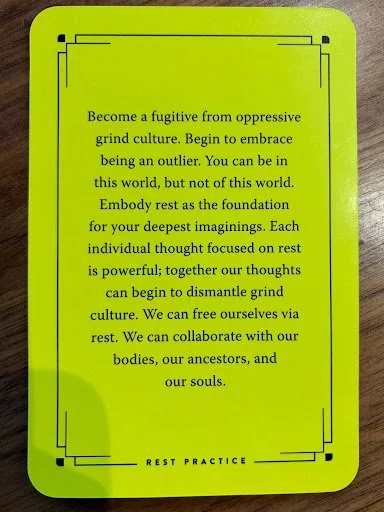
A card I drew during the fellowship from The Nap Ministry’s Rest Deck.
Doing so was incredibly difficult, in part due to deeply-engrained norms of productivity and responsibility that kept rearing their heads against the idea that health is more important. It is one thing to believe in your head that rest, self-care, and joy are (or should be) extremely high on the priority list. For me, it was quite another to put that into practice when there were so many people I cared about relying on me at work. I could not bring myself to engage in the self-care that was required until insistence from my doctor, family, and friends made me realize that was the only path I could realistically manage to take.
I applied to the fellowship while on medical leave; I expected that by the time the fellowship started I would have returned to work. That turned out not to be possible, and when I was accepted into the fellowship I struggled with whether or not to go ahead. For months, I had purposefully tried to stay away from anything connected to work, and had hardly interacted with anyone outside of family and close friends. I worried about whether I’d be able to manage the fellowship activities and social interactions, and offer anything of value to others.
After talking with the organizers about my situation and getting their warm and enthusiastic invitation to join, I decided to do so as a way to start easing back into the idea of professional life after medical leave. I am very glad I did, as it turned out to be exactly the right experience at a pivotal moment. The emphasis on care, self-care, and joy were validating at a time when I struggled with feelings of guilt for not being at work. And being able to connect with other amazing people in the fellowship reminded me of the importance of community at a time when I had spent months being largely isolated professionally.

When we came together in Vancouver the trees were in full spring bloom. I took this image of cherry blossoms a few days before our in-person meetings.
What I didn’t know at the time was that I would soon undergo yet another significant change in my professional life: shortly after the fellowship ended, it became clear that my health situation meant I needed to step down from a leadership role I had held for a number of years. This has been in some ways even more difficult than going on leave, with significant grief from missing so many incredible people, as well as guilt that lingers as I still wrestle with focusing on health over work.
My experiences during the fellowship have helped me to sit with these challenges and manage through this transition. The care, the self-reflections, the conversations and connections that I experienced during the fellowship continue to help remind me that prioritizing health—and therefore being better able to be present with family, friends, and colleagues—is the right move.
Our time in the fellowship, and our continued connections afterwards, also remind me that building and sustaining relationships can bring much-needed joy and mutual support as we all confront our various monsters.
Communities of care
The question I brought to the fellowship is of course still applicable even after I have left a formal leadership role: how can we lead, in whatever shape our particular leadership takes, in ways that support ourselves and others in times of stress and overwhelm?
“How can we lead, in whatever shape our particular leadership takes, in ways that support ourselves and others in times of stress and overwhelm?”
Through reviewing my fellowship experiences and writing this blog post, I am now realizing that the shape of the fellowship itself offers one possible answer (among others). Coming together in communities where we bring our whole selves and challenges, and where care and joy are prioritized as essential parts of “the work,” can support renewal, energy and creativity. It can help us build connections that sustain us and amplify our efforts. And when we are bent and bowed by monstrous times, it can help us hold each other up.
About the Author

Christina Hendricks is a Professor of Teaching in philosophy at the University of British Columbia, Vancouver, which is located on the traditional, ancestral, and unceded territory of the xʷməθkʷəy̓əm (Musqueam) people. She is an open education practitioner, researcher, and advocate, and is series editor for a set of open textbooks in philosophy published with the support of the Rebus Community.
Her other areas of interest and work in education include decolonization, equity, accessibility, and AI and ethics.
Confronting Monsters with Care and Joy © 2026 by Christina Hendricks is licensed under CC BY-NC-ND 4.0