
A Different Taste of Leadership
This post is the one of many capstone projects from the inaugural 2026 cohort of the Rebus Luminary Fellowship for Education Leaders. Each Luminary Fellow was invited to share a reflection with the broader community. Today, we hear from Megan Zara, founder of The Open Practice Academy.
As our cohort closes out the inaugural Rebus Luminary Fellowship for Education Leaders, we’re each sharing reflections on what this experience has meant, made possible, unsettled, and changed in us. I’ve only read a few so far, and already, they feel like small windows into the room we built together. Each reflection carries a completely different perspective, but they seem to speak from the same deep place: care, honesty, imagination, responsibility, and a refusal to settle for shallow answers about leadership or change.
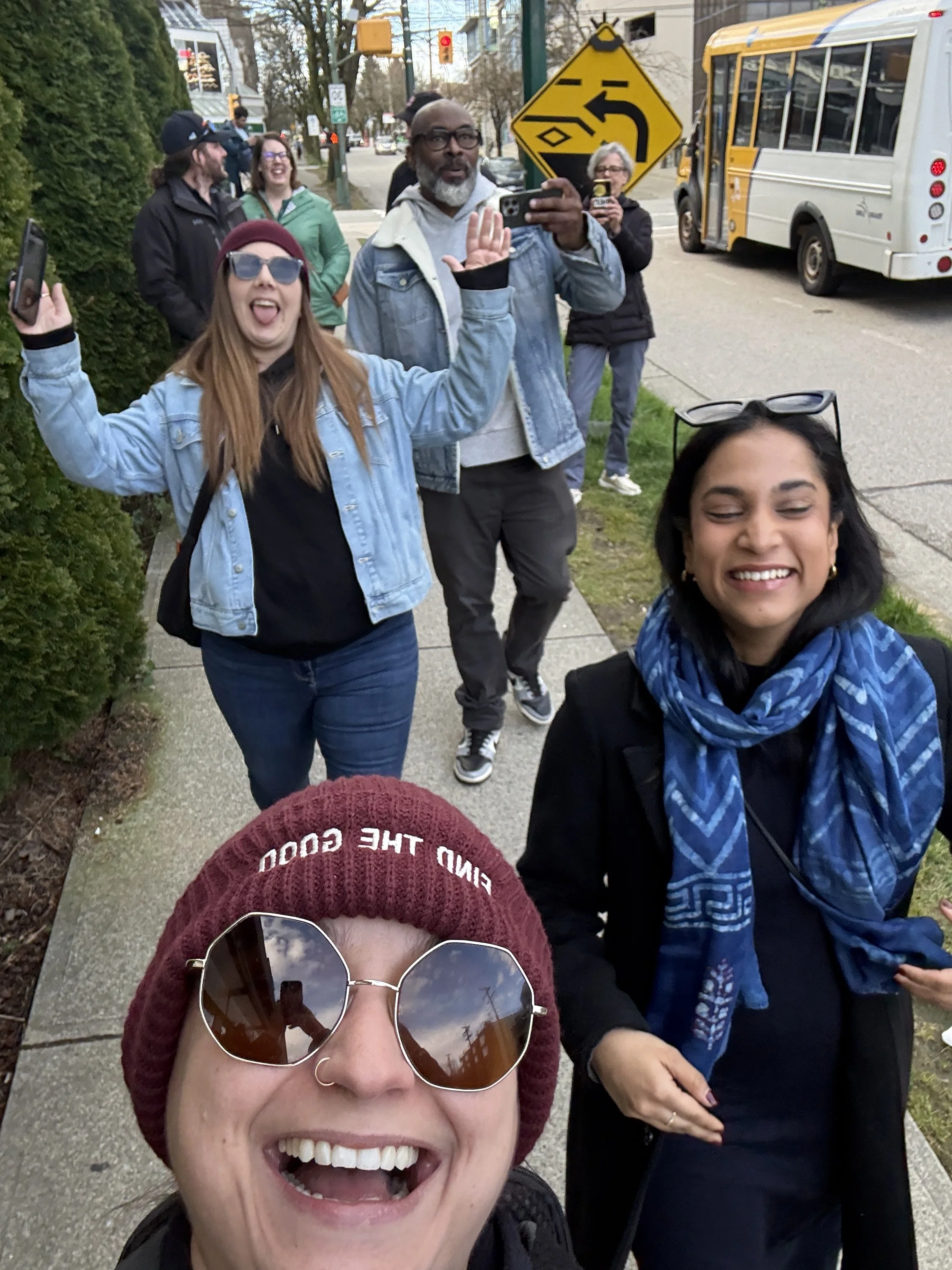
Walking together during the Rebus Luminary Leadership Fellowship. This cohort gave me more than leadership development; it gave me people, care, and a different way to imagine the work.
Together, these reflections helped me understand that I wasn’t writing this piece alone, even though these words are my own. I’m writing in conversation with a cohort that has already been brave enough to tell the truth. Their reflections reminded me that fellowship isn’t only what happens during meetings, workshops, shared meals, or structured time together. Sometimes fellowship is what continues afterwards, when one person’s honesty gives another person permission to go deeper.
Integrity in Public
The support I felt in this Fellowship mattered because it met me at a moment when I was already questioning what kind of leadership I could keep practicing, and at what cost. I kept thinking about the old definition of integrity: What do you do when no one is watching?
During the Fellowship, another question started forming, quietly at first, then with the force of something I couldn’t unhear: What do I do when everyone is watching? Do I honor myself, tell the truth about my capacity and my limits? Or do I fall in line because it’s easier to be praised for endurance than to be honest about harm?
That question named a tension I’d been living inside for a long time. I’d been championing Open Education, access, care, and equity while struggling to feel those same values applied to me as the person doing the work. It’s a strange kind of loneliness to build programs around openness while feeling closed in; to be recognized for doing the work while knowing, deep down, that the work was costing too much.
The loneliness was also shaped by my positionality. I entered the Fellowship as a practitioner, someone accustomed to building programs and questioning the structures around them, an OER librarian, a cis-gender woman, a neurodivergent person, and someone without a doctorate in a room where most people had one. Autism and ADHD have taught me to pay attention differently: to notice the hidden instructions, unspoken norms, places where something sounds inclusive but is still asking people to contort themselves to belong. That kind of noticing is a gift, but it’s also heavy. Once you see the thing under the thing, you can’t always unsee it.
“The Fellowship gave me a place to be just me and practice truth-telling. It was one of the most open, generous, deeply human professional spaces I’ve ever been part of. ”
The Fellowship gave me a place to be just me and practice truth-telling. It was one of the most open, generous, deeply human professional spaces I’ve ever been part of. The people leading it didn’t just invite honesty; they practiced it themselves by sharing openly, making room for uncertainty and vulnerability, and responding to ours with care rather than judgement. Our cohort met three times virtually before we gathered in person at the end. The virtual sessions were lovely and open, I learned so much there about finding joy, making space, and building comradery from a distance. That’s where I first encountered liberatory leadership, and it cracked something open in me: a way of leading that values humans and their needs over the organization and its plans, named and practiced more intentionally than I’d ever seen before.
And still, openness didn’t mean everything was automatically accessible. Because access is not a vibe. It lives in the pacing, the follow-up, the emotional permission to ask for what you need. It lives in how a group responds when someone says, “This isn’t working for me yet.”
I’ve spent the last few years building pathways into Open Education from that belief; badge programs, mini-grants, faculty support structures. But much of what made them work happened in the background: the follow-up after someone seemed unsure, the translation between big value and what someone needed to do by Friday. I’ve called this hinge work: the middle structures that connect values to actions.
But somewhere along the way, I had to ask a harder question: What happens when being the hinge begins to require something of the person doing it that conflicts with the value the work is supposed to embody? Recognition is beautiful. It matters. But if openness, care, and equity are visible in what I build for others, while the work depends on my own exhaustion or self-erasure, something has gone wrong.
Part of my own struggle was connected to accommodations. Not only needing them, but trying to get the right ones. An accommodation on paper doesn’t automatically mean access in practice. There’s a particular exhaustion in having your needs documented and still feeling unsafe inside the interpretation of that documentation. I’m not interested in turning this into an accusation. I’m interested in telling the truth: I was doing the work, documenting the work, trying to make it more humane, and I was tired in a way that wasn’t solved by a weekend off.
Questioning My Truth
The Fellowship didn’t hand me an easy answer to that problem. It gave me people, language, and space — a room where leadership wasn’t treated as dominance, and where integrity wasn’t only about what we owe others, but what we owe ourselves.
That last part changed me. Integrity to others is not the same as integrity to myself. When someone needs something, I show up. When I care about a value, I try to make it practical. That has been one of my strengths. It’s also been one of the ways I disappeared from my own life.
The old definition of integrity, what do you do when no one is watching, is the easier version for me. The harder question is what I do when everyone is watching: when a room full of people has decided that my reliability is part of the infrastructure. Do I still tell the truth? Do I still let myself be human?
For me, that question is inseparable from neurodivergence. What do I do when my body is telling the truth before my words can catch up? Do I mask? Do I overperform? Or do I practice integrity by staying present to my actual self? For many neurodivergent people, professionalism has meant hiding the labor it takes to participate. The Fellowship helped me see that being honest about access isn’t a failure of leadership. It is leadership.
“ If I believe care is infrastructure, I have to stop treating my own care as an exception. ”
If I believe care is infrastructure, I have to stop treating my own care as an exception. This was a bitter truth I had to swallow.
The Miracle Berry
At the in-person retreat, we tried miracle berries - small berries that temporarily change how you experience taste. Sour things become sweet. A lemon wedge becomes almost impossible to believe. You know what you’re eating. You know what sour is supposed to taste like. And still, your mouth tells you something different. I haven’t stopped thinking about how something can be sour and sweet at once, depending on what you’ve been given to taste it with.
The miracle berries had me questioning what my senses had taught me to expect while also trusting what I was actually experiencing. The Fellowship asked me to trust my own knowing in much the same way. There’s knowledge that comes from practice, from surviving systems and still trying to make them more humane. There’s knowledge that comes from your nervous system saying something is off here, and learning to trust that signal enough to investigate it. In the cohort, I was met as someone with knowledge, including knowledge shaped by my positionality and practice, without having to first prove it through a PhD. Unexpectedly, there was less distance between the person I knew myself to be and the person I felt permitted to be in the room. That felt like integrity.
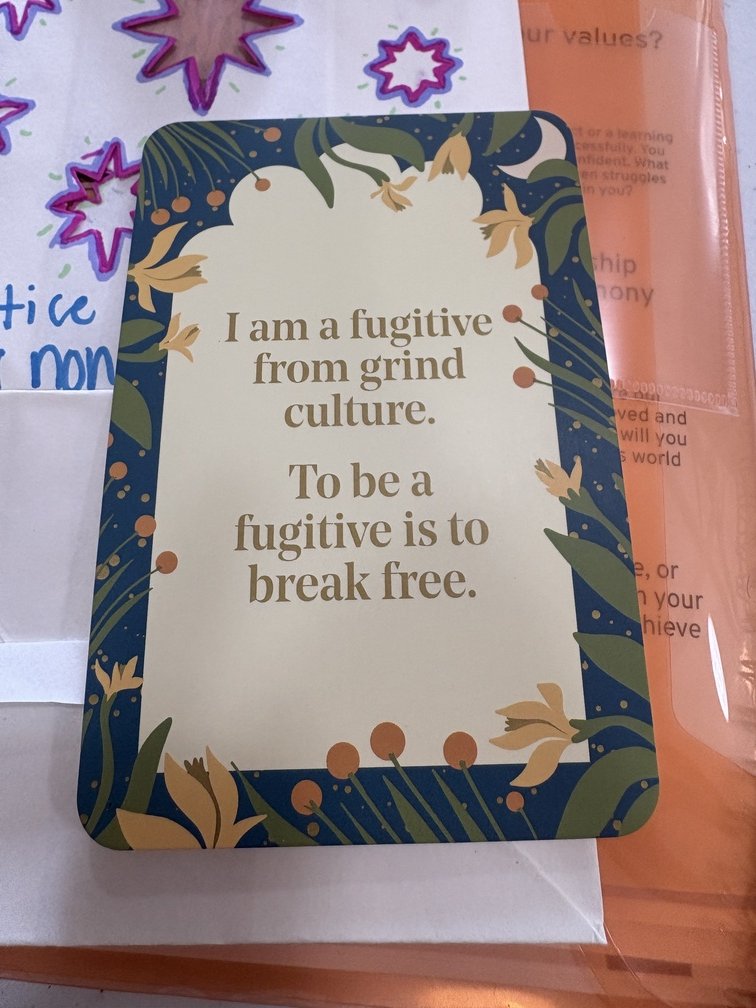
A card from our fellowship gathering that stayed with me. “I am a fugitive from grind culture. To be a fugitive is to break free.”
If I have one critique of the Fellowship, it is that I wish more of that relational foundation had been intentionally built earlier. I’ve since started my PhD, and our cohort recently spent a week together in person for our first residency. We met face-to-face before we were expected to do the deeper work of learning together online. Building those relationships in person first made what came after, the virtual learning, the harder conversations, the uncertainty, feel more grounded and purposeful. Our Fellowship retreat eventually gave me that same feeling of being truly known. I found myself wondering what might have been different if we had gotten to know one another that way earlier, so that more of our virtual time could have been built on ground we had already stood on together.
That distinction matters for Open Education, too. So much of our work is about access to knowledge, but access is incomplete if the structures around knowledge still reproduce patterns of exclusion: whose knowledge counts, who feels authorized to contribute it, and what parts of ourselves we believe we have to leave outside the room. The Fellowship helped me ask those questions not only about the programs I build, but about my own life.
There is Sweetness in Leaving
During the Fellowship, I came to learn that sometimes leadership is leaving a system that doesn’t care for you. This is not abandonment, failure, or proof that you aren’t committed enough, but as an act of integrity.
The Fellowship didn’t necessarily make the decision easy, or remove the grief, fear, or uncertainty. It gave me enough clarity to recognize that I couldn’t keep building care-centered work by abandoning myself inside systems that didn’t know how to care back.
The age-old phrase is that you can’t pour from an empty cup. I understand why people say it, but I think I’m reaching for something slightly different. I’m less interested in telling people to refill their cups and more interested in asking why so many of our systems are designed around constant pouring. Why is leadership so often measured by how much of ourselves we can give away? Why is care treated as proof of character instead of a shared responsibility? Why do we celebrate the person carrying the whole thing instead of changing the conditions that made one person necessary? Why do we call people resilient when what we really mean is that they’ve learned how to keep functioning without enough support?
“I’m less interested in telling people to refill their cups and more interested in asking why so many of our systems are designed around constant pouring. Why is leadership so often measured by how much of ourselves we can give away? Why is care treated as proof of character instead of a shared responsibility? Why do we celebrate the person carrying the whole thing instead of changing the conditions that made one person necessary? Why do we call people resilient when what we really mean is that they’ve learned how to keep functioning without enough support?”
What I learned is that I don’t want to simply tell people to rest, set boundaries, or honor their needs. I want to model a way of working where those things aren’t side notes. I want to build structures where care is not a reward for finishing the work, but part of how the work is designed.
That’s part of why I started The Open Practice Academy (TOPA). TOPA is terrifying because it’s not just a business idea. It’s a declaration that I want to do the work in the most authentic way I can. It’s an attempt to take what I built, what I survived, what I learned, and what I still believe, and make it available beyond one institution.
It’s rooted in a simple but demanding belief: values need pathways, care needs structure, and Open Education needs more than champions. It needs conditions where people don’t have to become martyrs to keep the work alive.
What I’m Carrying Forward
I entered the Luminary Fellowship looking for leadership development. I left with something more intimate and more durable. I left with friends. I left with global connections that feel less like networking and more like being returned to a search I’ve carried for years: the search for meaningful connection with people who are willing to think differently, work differently, and imagine otherwise.
I left with a stronger sense that leadership can be relational without being vague, joyful without being shallow, and structured without becoming rigid or extractive. I left with the reminder that bravery is not always loud and put together. Sometimes bravery is telling the truth about harm. Sometimes it’s letting yourself be seen as unfinished. Sometimes it’s refusing to keep performing wellness for a system that benefits from your silence. Sometimes it’s saying, “I need something different,” in a room full of people and trusting that the right room won’t punish you for this need.
Sometimes it’s tasting the lemon again and admitting that maybe it was never supposed to be sweet. Or maybe the sweetness was real, but incomplete.
That’s the thing about the miracle berry. It changes your experience, but not the fruit itself. The Fellowship didn’t change the systems I came from. It changed what I could taste inside them. It helped me notice which sweetness was real: the sweetness of community, laughter, shared meals, honest conversation, being treated as a peer, being recognized not only for what I produced but for how I think and who I am.
And it helped me notice which sweetness was manufactured: the kind of praise that makes depletion feel noble, the kind of recognition that asks nothing of the conditions around it, the kind of leadership that celebrates care while consuming the caring person.
Now I’m trying to live with that knowledge. Imperfectly, honestly, and in public. I’m trying to practice integrity not only when no one is watching, but when everyone is watching. I’m trying to honor the values I’ve spent years building for others by finally applying them to myself. And I’m trying to build from there.
Not from an empty cup. Not from a martyr story. Not from the hollow sweetness of being celebrated for surviving what should have changed. From care with structure. From openness with boundaries. From leadership that doesn’t ask us to disappear. From the possibility that we can gather differently, work differently, and make something more socially balanced together.
That’s what the Luminary Fellowship gave me.
Not certainty. Not a perfect plan.
A different taste of what leadership could be.
And enough courage to stop pretending the old one was feeding me.

About the Author
Megan Zara is a relational practice coach, learning strategist, and writer, and the founder of The Open Practice Academy, operated under her company, She Writes, She Reigns, LLC.
Her work keeps circling one question: how do the values we say matter become visible in the way we actually practice? She asks it of educators, organizations building systems that don't depend on anyone's heroics, and individuals whose values and daily reality have quietly drifted apart — always through the same method: notice what's happening, examine what's underneath it, decide how to respond.
Megan's path through literacy, instructional design, libraries, and neurodivergence shaped a conviction that access isn't only about what we create, but the conditions that let people enter, participate, and belong. She is currently beginning her PhD in Leadership and Change at Antioch University.
Author’s Note
For this reflection, I used Notion AI as a thinking partner and editor. I shared my raw notes, themes, draft ideas, and related writing from my Notion workspace, then used AI support to help organize the narrative, surface connections across my work, and shape the piece for clarity, rhythm, and flow. I reviewed, revised, and made decisions throughout the process. The experiences, interpretations, and conclusions are my own. Notion AI supported structure and revision, but the reflection is grounded in my lived experience, professional practice, and ongoing reflective work.
A Different Taste of Leadership © 2026 by Megan Zara is licensed under CC BY-NC-ND 4.0