

Discovering What Matters Amidst Grief and Burnout
This post is the one of many capstone projects from the inaugural 2026 cohort of the Rebus Luminary Fellowship for Education Leaders. Each Luminary Fellow was invited to share a reflection with the broader community. Today, we hear from Ginelle Baskin, Open Education Librarian at Middle Tennessee State University.
When I arrived in Vancouver last March for the in-person gathering for the Rebus Luminary Fellowship, I was exhausted. No, scratch that; I was more than exhausted. I felt depleted in every way possible—mentally, physically, and emotionally. Which is not a great state of mind to be in when you are there to take part in a once-in-a-lifetime opportunity. Not only was I feeling burnt out at work, which seemed to have a never-ending list of challenges, but I was also feeling burnt out at home. For the past several years, I had been caring for my aging parents while also working full-time and being a mom, wife, etc. To put it simply, life was very busy and overwhelming. Each day felt like a never-ending “to do” list to get through. I was not exactly a joyful person. Rather, I was simply trying to keep my head above water every day. I was in perpetual survival mode.
The Rebus Luminary Fellowship brought together fifteen postsecondary education leaders from across the United States and Canada for three months of virtual conversations and an in-person gathering in Vancouver. The fellowship focused on cultivating sustainable, authentic, and liberatory leadership. I applied because I hoped the fellowship would help me reconnect with the sense of joy and possibility that first drew me to open education. I was looking for practices that could help me sustain myself while the demands of my OER work continued to grow.
So, here I was, arriving in another country, out of my normal environment, plopped into this group of strangers who I knew a little from a few Zoom meetings, feeling unsure if I even deserved to be there. I was also feeling guilty for leaving my father, who was under hospice care in an assisted living facility back home. Honestly, I was unsure of what I expected to get out of this experience or what I could contribute to the group.
As we eased into our fellowship activities on the first day and I started getting comfortable around the other participants, I began to relax and realize how fortunate I was to be chosen for this experience. Others, like me, were also arriving exhausted and overwhelmed. Yet, here we were together in this special place. Despite our individual insecurities and all the ongoing challenges in our lives, we had made it to Vancouver to pause from our hectic schedules and recharge.
We spent those three days together challenging ourselves to be vulnerable (which is especially hard for an introvert like me) and getting to know each other. We took walks in between sessions to the nearby market for lunch and talked about our families, our hometowns, and our life experiences. It felt safe to pause and breathe for a moment. No emails to respond to, no faculty meetings about projects, no looming deadlines. Just space to be, and it felt good.
“No emails to respond to, no faculty meetings about projects, no looming deadlines. Just space to be, and it felt good.”
Of the virtual sessions, I especially appreciated the opportunities for reflection through journaling because we often don’t give ourselves intentional time for that during the workday. It was nice to have a few peaceful moments to slow down and reflect. The journaling gave me the space to consider questions like “How can I take care of myself?” and “How can I build trust in myself?”. I also enjoyed the breakout room activities, which gave me opportunities to connect more deeply with the other participants. As someone who finds small-group activities easier than large-group discussions, I appreciated having those opportunities to get to know the other fellows.
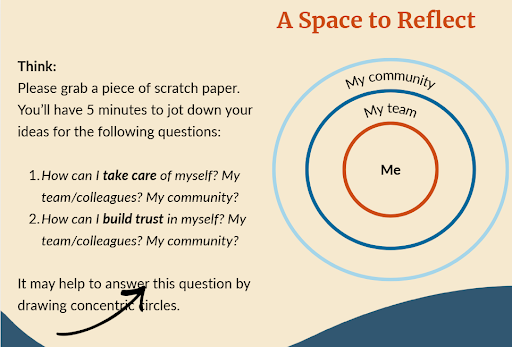
A reflection activity from one of the fellowship’s virtual meetings.
Those three days in Vancouver gave me a lot to think about as well. Looking back on the full experience now, several ideas and practices have stuck with me and have changed how I want to approach both my work and my life.
1 - Building a Culture of Care
One of the things that stood out to me throughout the fellowship was the emphasis on creating space for care—not just for ourselves, but for the people around us. This made me think about what it means to build a culture of care in my own life and workplace. One way I can practice care for myself is to ask for help when I’m overwhelmed. It’s not a sign of weakness but an act of strength. On our last day of activities in Vancouver, they had us write down one specific liberatory practice we promised to do once we got home, and mine was to ask for help at work.
I’ve made small but intentional progress since returning home. I’ve enlisted the help of a colleague on several tasks related to Pressbooks projects, such as proofreading projects before publication and helping with accessibility remediation. Utilizing her expertise has not only helped lighten my workload and stress level, but it’s felt good to have someone to collaborate with rather than carrying everything solo.
I’ve also been thinking about how I can prioritize well-being in my interactions with others. One small practice I’d like to incorporate into future meetings is to provide a few moments to just pause and breathe. How often do we rush from one thing to another all day long? And no wonder we’re all exhausted and stressed. I want to be more intentional about providing more space and opportunities for rest, reflection, and recharging, even if it’s just for a brief moment.
2 - Less is More
If I had to identify one practical change I’ve made since returning from Vancouver, it would be this: I need less on my plate, and that means learning to say no. In our fellowship, this practice was introduced as “Rest as Resistance.” This is a very hard concept for a people-pleaser! Yet, I’m learning the power and freedom that can come from saying no to things.
For example, while I wish I could be on every committee and project that interests me, I just can’t do that and keep my sanity. I’ve realized that saying yes to everything doesn’t necessarily mean I’m contributing more. Sometimes, doing less allows me to give more attention and energy to the things that really matter.
When I got home, I took stock of everything at work that was stressing me out and have intentionally started pulling back from a few projects. For me, saying no, cutting back, and asking for help aren’t about caring less. They are ways of making room to care about the things that matter most.
“Sometimes, doing less allows me to give more attention and energy to the things that really matter.”
3 - The Power of the Pause
One of the most impactful fellowship activities for me was a meditation activity we did on the first day. They asked us to close our eyes and walked us through visualizing ourselves ten years in the future in our favorite happy place. What does that place look like? What does it feel like? And who else is there with you?
I pictured myself in a healthier body and state of mind, peaceful, happy, surrounded by family. Nothing related to work was there.
That exercise has stayed with me because it reminded me of the power of simply stopping long enough to think about what I actually want and need.
I’m trying to be more intentional about taking mental breaks during busy times. Sometimes that means leaving an email unanswered so I can leave on time at the end of the day, or it might mean taking a couple of hours for myself on a Friday afternoon.
I’m learning that a pause isn’t wasted time. Sometimes, stepping away from the constant “to do” list is exactly what allows us to breathe, reflect, and reconnect with what matters.
4 - Life is More Than Work
The meditation exercise also led me to another realization: life is more than what I accomplish. I can care deeply about my work without it being the only thing I care about.
Working in higher education, we can easily find ourselves defining ourselves and our worth based on our job, rank, and accomplishments. I’m trying to break away from that mentality. While I care deeply about my work, I choose not to be defined by it.
“While I care deeply about my work, I choose not to be defined by it. ”
Instead, what matters most to me is my faith, my family, my health, and my relationships with the people I love. That’s what I was visualizing in my happy place.
There is another part of this realization that became much clearer after I returned home.
After the fellowship, my father’s health worsened, and I spent the next several weeks at his side preparing for his passing, which happened two months later. It was an especially difficult time for me, as I had already lost my mother a few years prior.
Going through this difficult time helped me confirm what really matters in my life and what I had already been discovering through the fellowship. The people we love, the relationships we build, our health, our faith, and the time we have together matter so much more than how many things we accomplish or how much we can check off our to-do lists.
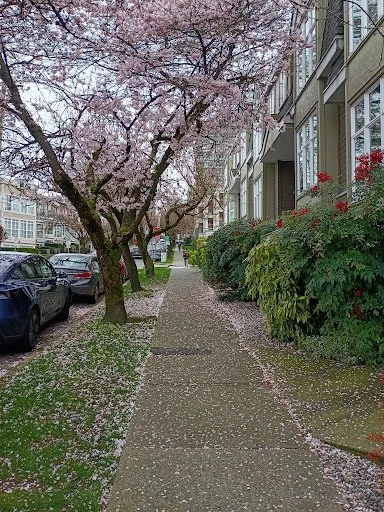
The daily walk back to my hotel after our fellowship sessions on Granville Island.
This quote from author Morgan Harper Nichols resonates with me: “I am giving myself permission to add my own health and well-being to the list of things I care about.” We so often put ourselves last on our lists of what matters, and I know I am guilty of that. Overall, I come away from this fellowship knowing that I need to focus more on my own health—physical, mental, and emotional—and to make intentional space for the people and things that give my life meaning.
Moving Forward
So, what happens now that the fellowship has ended and we’ve all returned to our busy lives and schedules? For me, it means approaching the new academic year a little differently. As my calendar and “to-do” list ramp up over the coming weeks, I am taking an intentional step back and revising my “to-do” list.
I want to build a culture of care. For me, that means prioritizing well-being, making space to slow down, and being more mindful of the pressure to always be doing more. I want to extend that same care to the people around me, creating space for them to pause, breathe, and take care of themselves, too. I want to recognize that less can be more. I want to make space for the power of the pause. And I want to remember that my life is more than my work.
I am giving myself the time and space to grieve the loss of my father, and I am keeping some space for myself. Space to find care, to find rest, and to find joy again.
About the Author
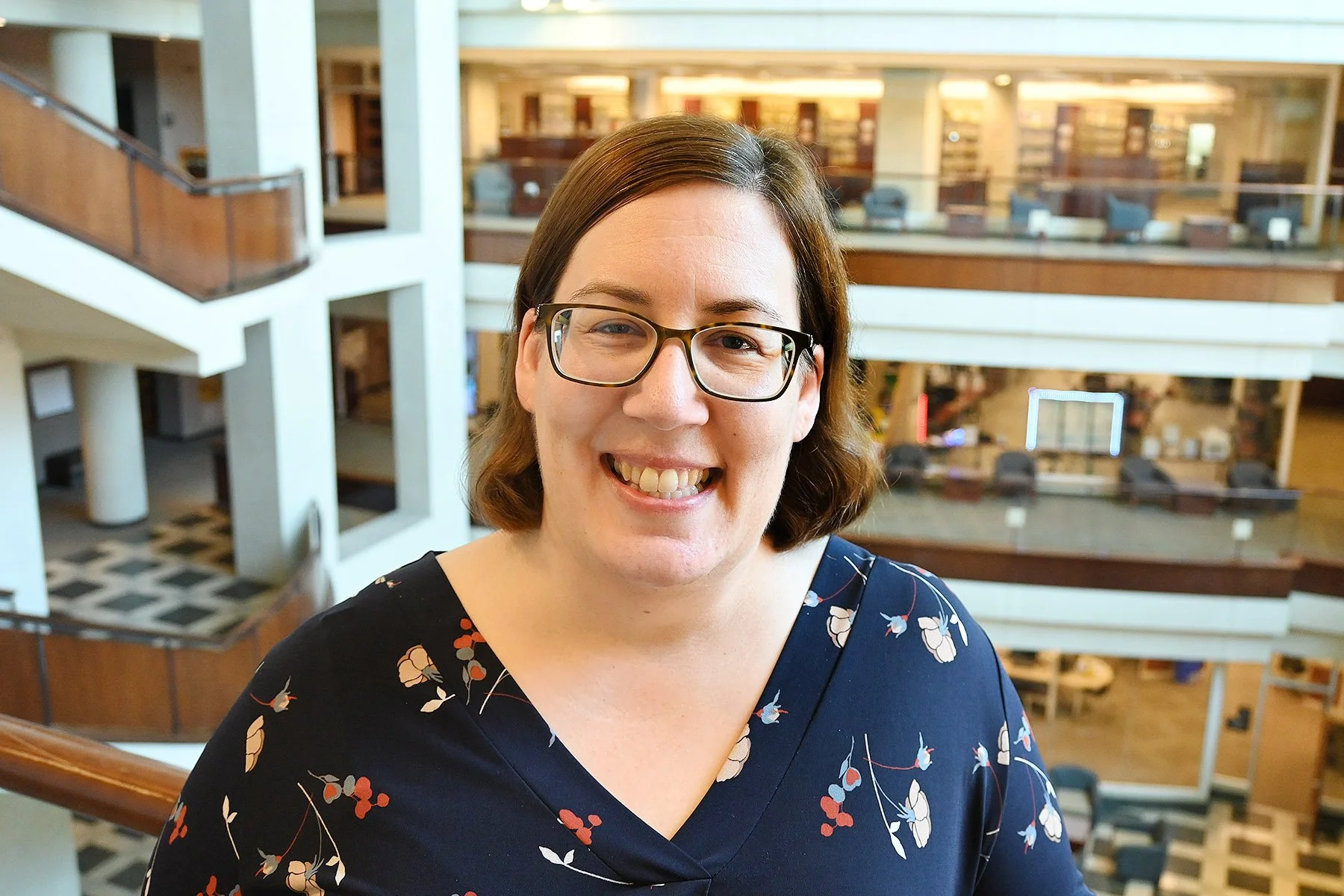
Ginelle Baskin is an Open Education Librarian at Middle Tennessee State University, where she leads initiatives focused on textbook affordability, open educational resources (OER), and Zero Textbook Cost (ZTC) courses. She works with faculty, departments, and campus partners to support the adoption, adaptation, and creation of OER and to reduce financial barriers for students.
Discovering What Matters Amidst Grief and Burnout © 2026 by Ginelle Baskin is licensed under CC BY-NC-ND 4.0