
This post is one of the many capstone projects from the inaugural 2026 cohort of the Rebus Luminary Fellowship for Education Leaders. Each Luminary Fellow was invited to share a reflection with the broader community. Today, we hear from Kim Grewe, an instructional designer at Northern Virginia Community College Online Learning.
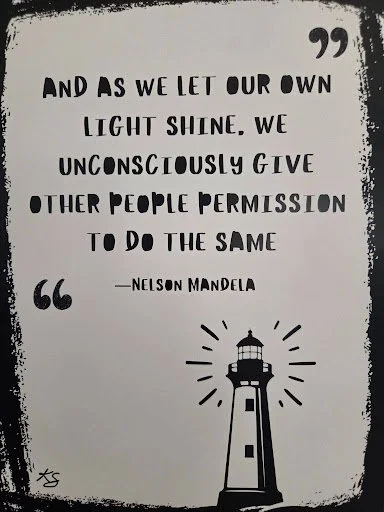
A print from my Luminary Fellowship welcome package, now hanging on my wall at home.
One of the first things I noticed at the Luminary Fellowship gathering in Vancouver, B.C., this past March was the space in the schedule. We did not begin each day in a rush or fill every hour with activities. Instead of pre-conference workshops, there was an open invitation to join colleagues around the corner for coffee. Instead of an opening keynote, there was a ceremony with song led by a local Indigenous leader, making time to honor the place, the people, and the wisdom of elders and teachers, past and present. Instead of rushing through a crowded vendor hall, there were leisurely walks to local markets, where we explored food options and got to know one another. Instead of a packed conference hall, there was a small, intimate gathering of Luminary Fellows. Instead of a large, flashy conference center, we met at a local community center. Instead of an expensive resort set apart from its surroundings, we stayed at the downtown Holiday Inn, comfortably within the community. There was time to reflect, to start slowly, and to talk with one another as people, without needing the conversation to accomplish anything. There was time for silence and journaling, for calming music and selections from personal Spotify playlists, and for processing and sharing the thoughts that emerged. That spaciousness and grounding was itself a lesson in how we might sustain ourselves as leaders in open education.
The Rebus Luminary Fellowship brought together 15 postsecondary education leaders from Canada and the United States to explore more sustainable, authentic, and liberatory ways of leading. Hosted by the Rebus Foundation in partnership with the Leadership Learning Community, the three-month program combined monthly virtual community gatherings with a 3-day in-person summit in Vancouver, BC, creating space for us to slow down, learn alongside one another, and imagine leadership rooted in care, connection, and collective possibility.
During one exercise, we were invited to travel through time using our imaginations. Meeting my past self came easily. I could see the person I had been with affection and understanding. I have made mistakes, of course, but I do not need to punish that earlier version of myself for them.
Meeting my future self was different. I saw nothing. The only picture I could summon was of myself still sitting at a computer, working long hours, and worrying about money. I could not imagine another way to support my household and find fulfillment in my work. I was surprised by that blank space, but I did not feel I had to fill it before I left the gathering. I carried it home with me.
About a week later, something began to shift. The conversations, the reflection, and the care built into our time together seemed to settle and take shape. I began to imagine more than one possible future. I wondered what it might look like to work alongside a community of women innovating in educational technology and open education, joined by a commitment to social justice, for example.
“I was beginning to practice imagination as part of liberatory leadership, even though I did not yet know what I would do with what I imagined. ”
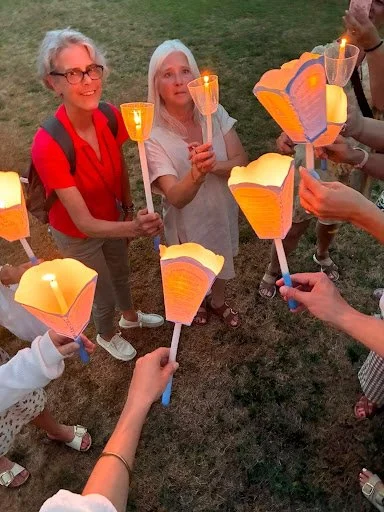
At Lourdes, France, with my yoga retreat friends, sharing the light of one another’s candles.
Later, at an art and yoga retreat in France, I found myself making connections among the fellowship’s eco-cycle, creative practice, meditation, yoga practice, nature, and the ways our lives and work change over time. One of our trips together took us to Lourdes, a place of divine inspiration and devotion to Mother Mary. Thousands of pilgrims from all over the world travel there, hoping for healing and grace. Each evening culminates in a candlelit procession, where pilgrims gather to sing and praise Mother Mary, asking for her healing and grace as they make their way around the huge underground cathedral. This procession brought many of my thoughts into focus. People from around the world walked together, each carrying a candle. We lit one another’s candles. I could approach a stranger and ask for a light; they would give it freely. My candle would burn, and theirs would burn just as brightly. Where there was one candle to start, there were now thousands of candles burning together.
“I was deeply touched by the sight of all those lights burning together, each one a reminder that we can share our light without diminishing our own.”
I keep returning to that moment. It gave me a lived image of shared power. We made more light together, and no one had to diminish their own to help another person shine. I recognize that same generosity in my fellow Luminary leaders. At our in-person gathering, they shared their light through thoughtful listening, encouragement, and the possibilities they helped me see. That sharing has continued since we returned home: we are presenting at conferences together, supporting one another’s work, and making room for what might come next. I can offer my light and receive theirs. These relationships are part of what makes leadership in open education sustainable for me, this ongoing practice of helping one another sustain the light.
My experiences from the Luminary Fellowship are also shaping how I lead in my current work. As an instructional designer working with faculty who bring different perspectives and priorities, I am learning to listen for the values beneath what people say. That helps me understand both what matters to them and where we may find common ground.
“I am also becoming more deliberate about naming my own values as an open educator: equity, access, generosity, shared power, and care. Making those commitments visible helps me put them into practice, especially when the work becomes difficult.”
Witnessing and naming are important parts of transparent, liberatory leadership. At one of the Luminary virtual sessions, we spoke about acknowledging the “monsters”—the tensions and fears that can shape our work even when no one names them. Recently, one of my faculty development teams reached an impasse. Meetings had become contentious, and we could not find a way forward together in that format. I named the disconnect and acknowledged that we might have to agree to disagree. Then I suspended our Zoom meetings, broke the project into individual tasks, and worked asynchronously with team members to complete it. We still had differences, but acknowledging them opened a practical path forward.
“For me, this was a lesson in attending honestly to what was happening and finding a realistic way to continue the work.”
I am practicing that same honesty with myself. I keep encountering the scarcity trap: the fear of not having enough, or of not being good enough. Naming it helps loosen its hold. My financial responsibilities remain real, but I am learning to recognize when fear is narrowing what I can imagine or how I choose to act.
“I want to approach my future professional self with optimism and hope and make decisions grounded in my values. The fear still returns. Increasingly, though, I can recognize it, name it, and make room for another possibility.”
Changes in my employment circumstances are making the question of my future much more immediate. New employment requirements mean I will need to leave a role I had expected to continue, bringing this transition sooner than I had anticipated. I still have real worries about money, about being the sole earner in my household, and about what I will need as I grow older. I understand now that fear was part of what made the future so difficult to picture during the fellowship exercise. The fellowship and the retreat did not make those worries disappear. They helped me make room for them while beginning to see possibilities beyond the one life I had assumed I must keep living.
I am still finding my way. What I carry forward from the Luminary Fellowship is both the permission to imagine and the knowledge that imagining need not be solitary. I think of the people at Lourdes, passing light from candle to candle. I think, too, of my fellow Luminaries, whose light sustains me and with whom I continue to share my own.
“That is a vision of leadership I can recognize and practice: creating the conditions for others to shine, accepting light when I need it, and trusting that there is more light when we share it.”
About the Author
Kim Grewe is an instructional designer and open education leader whose work centers equity, relationships, and shared learning. As she explores the next chapter of her professional life, she is drawn to collaborations that help educators imagine possibilities and put their values into practice. She sees sustainable leadership as sharing light—helping others shine while drawing strength from the light they offer in return.
Lighting One Another’s Candles © 2026 by Kim Grewe is licensed under CC BY-NC-ND 4.0